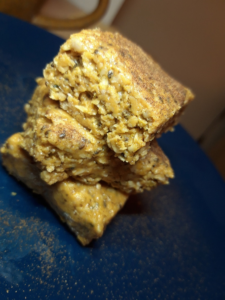
I love how simple it is to make your own chocolate at home, and adding roughly chopped macadamia nuts gives this version a delicious crunch. It’s quick and simple to make, with no complicated techniques or special equipment needed.
The result is rich, nutty chocolate with plenty of macadamia pieces throughout — perfect as an occasional homemade treat.


Ingredients
- 120 g Macademia nuts
- 40g cacao butter buttons
- 2 tbsp cacao powder
- 1 tbsp almond butter
- 1 tbsp honey
- 2 tbsp milk powder
Method
- Place the macadamia nuts in a blender and pulse until roughly chopped. Avoid over-blending, as macadamia nuts are naturally high in oil and can make the chocolate mixture too soft.
- Melt the cacao butter and almond butter together in a saucepan over low heat.
- Add the cacao powder, honey and milk powder, and stir until smooth.
- Stir in the roughly chopped macadamia nuts until evenly combined.
- Pour the mixture into silicone chocolate moulds.
- Refrigerate until firm. Makes: 6 chocolates (one bar: 11.4 x 4.5 cm)
No chocolate mould? Simply pour the mixture into a tray lined with baking paper, spread it evenly, and refrigerate until firm. Once set, cut or break the chocolate into pieces.
Nutrition Information
| Per 1 × 1 bar — 37g %Reference Intake RI |
| Energy 992.6 kJ / 237.1kcal | 12 % |
| Fat 22 g | 31 % |
| Of which Saturates 7 g | 35 % |
| Of which Mono-unsaturates 11.2g | |
| Of which Poly-unsaturates 0.6g | |
| Carbohydrate 7.5g | |
| Of which Sugars 5.2 g | |
| Of which Starches 0.2g | |
| Fibre 1.8g | |
| Protein 3.1 g | 6 % |
| Salt 0g | 0 % |
| Vitamin C 0.5mg | 1 % |
| Vitamin A 6.8 µg | 1 % |
| Calcium 41.9mg | 5 % |
| Iron 0.5 mg | 4 % |
* Reference Intake Values are based on a 2,000 calorie diet. Your daily values may be higher or lower depending on your calorie needs.
But macadamia nuts are more than just a delicious ingredient

Macadamia nuts have an interesting nutritional profile, providing protein, fibre, vitamins, minerals and a range of phytochemicals (Munro and Garg 2008).
One characteristic of nuts, including macadamia nuts, is their relatively high ratio of monounsaturated fatty acids (MUFAs) to saturated fatty acids (Griel et al. 2008).
But what are MUFAs?
Monounsaturated fats (MUFAs) are one of the two main types of unsaturated fat. They’re found naturally in foods such as macadamia nuts, olive oil, avocados and almonds. The name comes from their structure: “mono” means one, referring to the one double bond in their fatty acids.
High in fat and calories – but what happens to body weight?
Macadamia nuts are particularly energy-dense, with around 75% of their weight coming from fat. But does adding them to the diet necessarily lead to weight gain?
In a randomised crossover trial, 35 adults with overweight or obesity consumed their usual diet plus macadamia nuts for 8 weeks, providing approximately 15% of their daily energy intake. Despite the additional energy intake, the researchers found no significant changes in body weight, BMI, waist circumference or body fat compared with the control group (Jones et al. 2023; Munro and Garg 2008).
A different approach was used in a 10-week study in which macadamia nuts replaced some of the saturated fat in participants’ usual diets, without increasing total energy intake. Despite the high fat content of macadamia nuts, this substitution did not result in weight gain and was associated with a modest reduction in waist circumference compared with the control diet (Somerset et al. 2013).
The Nut Comparable to Olive Oil

Researchers suggest that MUFAs and other unsaturated fats may be used more readily for energy (a higher rate of fat oxidation) than saturated fats, with less tendency to be stored in body fat (adipose tissue) (Jones et al. 2008).
Although no studies have directly investigated the effects of macadamia nuts on fat oxidation and the thermic effect of food (the energy the body uses to digest and metabolise food), the findings from olive oil research may still be relevant because macadamia nuts contain high amounts of oleic acid, the same monounsaturated fatty acid (MUFA) that is abundant in olive oil (Jones et al. 2008).
In a study comparing olive oil with cream (rich in saturated fat), meals containing olive oil resulted in a significantly greater thermic effect of food and higher fat oxidation, meaning the body burned more fat for energy, five hours after consumption (Jones et al. 2008).
But here’s something interesting
Not all of the calories in whole nuts are absorbed. Their tough cell walls trap some of the fat, allowing part of it to pass through the digestive system undigested. This means that not all of the energy theoretically calculated from the fat, protein and carbohydrate in whole nuts is necessarily absorbed by the body (Jones et al. 2008).
This is supported by studies on almonds, walnuts, pistachios and cashews, and researchers think the same is likely to apply to macadamia nuts, although there have been fewer direct studies on them. This concept is known as metabolisable energy—the amount of energy your body actually absorbs and can use, rather than the amount predicted from the food’s nutrient composition (Jones et al. 2008).
The combination of fat, protein and fibre may also help you feel fuller after eating nuts, which may help reduce hunger and support appetite control. (Jones et al. 2008).
Good for the heart
Previous research has suggested that replacing saturated fat with macadamia nuts may improve some blood lipid markers. Griel et al. (2008) investigated this in a randomised crossover study in mildly hypercholesterolaemic (high cholesterol) men and women. Participants consumed 1.5 ounces (42 g) of macadamia nuts per day, and the macadamia-nut diet resulted in reductions in total and LDL cholesterol compared with the control diet. (Griel et al. 2008).
Key takeaways
- Macadamia nuts are nutrient-dense, providing fibre, protein, vitamins, minerals and phytochemicals.
- They are particularly high in monounsaturated fats (MUFAs), including oleic acid.
- Despite being high in fat and calories, studies have not shown weight gain when macadamia nuts were added to or substituted into the diet over the study periods.
- Not all of the calories in whole nuts are absorbed, which may help explain why they don’t always lead to weight gain.
- Research on macadamia nuts has also found reductions in some blood lipid markers, particularly LDL cholesterol, although findings have not been consistent across all studies.
Interested in the connection between diet and period pain? I’ve written more about how nutrition may influence painful periods in my article: Does your diet cause period pain?
Want support with your own health and nutrition? If you’re looking to achieve a healthy weight, lose weight sustainably, or find ways to manage painful periods through nutrition and lifestyle, I can help.
Visit my website to explore my nutrition programmes or book a free 15-minute discovery call to see how I can support you.
References:
Griel, A.E. et al. (2008). ‘A Macadamia Nut-Rich Diet Reduces Total and LDL-Cholesterol in Mildly Hypercholesterolemic Men and Women’, The Journal of Nutrition, (138)4, pp. 761-767
Jones, J.L et al. (2023). ‘Macadamia nut effects on cardiometabolic risk factors: a randomised trial’, Journal of Nutritional Science, (12)55, pp. 1-10
Munro, I.A and Garg, L.G. (2008). ‘Nutrient Composition and Health Beneficial Effects of Macadamia Nuts’, Nutraceutical Science and Technology pp. 249-257
Somerset, S.M. et al. (2013). ‘Isoenergetic replacement of dietary saturated with monounsaturated fat via macadamia nuts enhances endothelial function in overweight subjects’, Clinical Nutrition, pp. 113-119