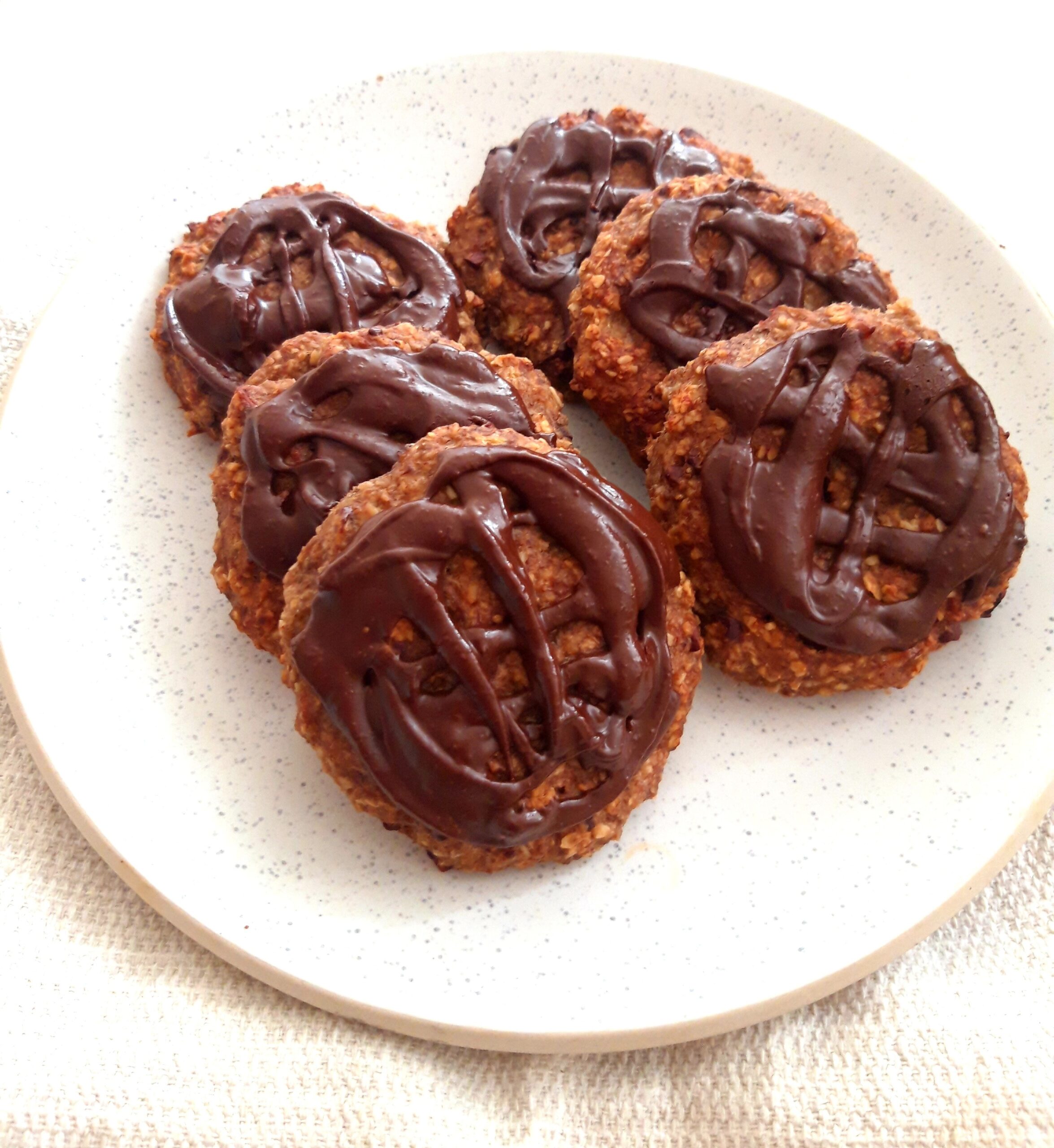
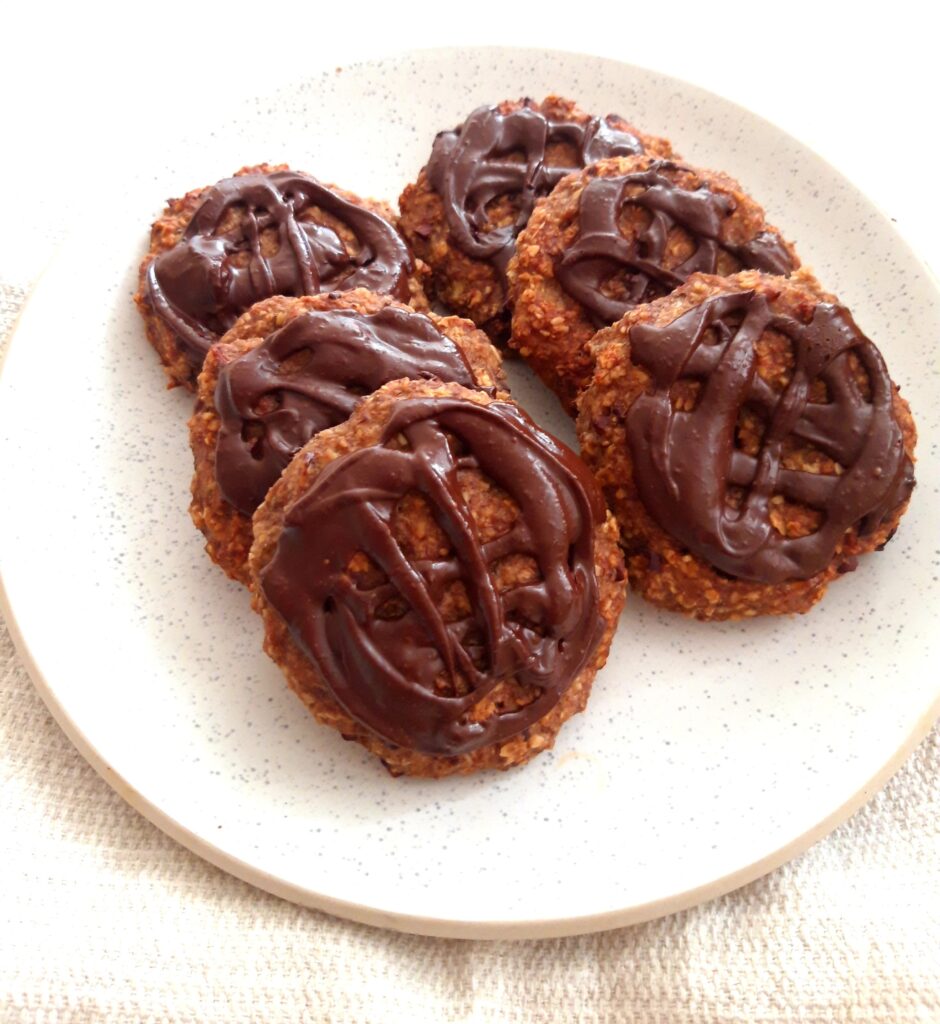
Got ripe bananas at home that nobody wants to eat? Don’t throw them away — turn them into something delicious and nourishing instead! These cookies are the perfect way to reduce food waste while making a naturally sweet, fibre-rich snack.
Made with oats and oat bran—both excellent sources of fibre, including beta-glucan—they help support steady energy, reduce blood sugar spikes, and promote balanced glucose levels.
Ingredients:
- 6 bananas
- 2 tbsp milled chia seeds
- 1/2 cup peanut butter
- 1//4 cup cacao nibs
- ½ cup oat bran
- 1 cup oat
- 90 g dark chocolate
- 2 tbsp almond butter
How to make
Peel the bananas and place them in a mixing bowl. Mash with a fork until smooth and creamy. Add the chia seeds, peanut butter, oats, oat bran, and cacao nibs, then stir until everything is well combined. With damp hands, shape the mixture into 12 cookies and arrange them on a parchment-lined baking tray. Bake at 180 °C for about 30 minutes, until set and lightly golden.
Meanwhile, gently melt the chocolate and almond butter together in a heatproof bowl over simmering water, stirring until silky smooth. Drizzle or spread the mixture over the baked cookies, letting it drip naturally for a delicious finish.
Nutrition Facts
| Serving Size: one cookie — 95g |
| Amount Per Serving | ||
| Calories | 229 | |
| % Daily Value* | ||
| Total Fat | 12.3 g | 16 % |
| Saturated Fat | 3.6 g | 18 % |
| Trans Fat | 0 g | |
| Cholesterol | 0.2 mg | 0 % |
| Sodium | 2.8 mg | 0 % |
| Total Carbohydrate | 28.5 g | 10 % |
| Dietary Fiber | 5.6 g | 20 % |
| Total Sugars | 11.9 g | |
| Added Sugars | 1.7 g | 3 % |
| Protein | 6.4 g | |
| Vitamin D | 0 mcg | 0 % |
| Calcium | 39.2 mg | 3 % |
| Iron | 2.1 mg | 11 % |
| Potassium | 385.7 mg | 8 % |
* The % Daily Value (DV) tells you how much a nutrient in a serving of food contributes to a daily diet. 2,000 calories a day is used for general nutrition advice.
Oats for Weight Management and Metabolic Health
Research shows that adding oats to a healthy diet can have powerful effects on weight and metabolic health in both the short and long term.
In a study by Li et al. (2016), participants were divided into four groups and placed on a low-fat, high-fibre diet for 30 days in a hotel setting. Three of the groups received different interventions: one consumed the healthy diet alone, while the other two replaced part of their cereals with either 50 g or 100 g of oats daily. After the 30-day trial, participants returned home but continued to be observed for a full year.
Here’s what the researchers found:
✨ Everyone lost some weight, but the people eating oats lost more weight and more inches from their waist.
✨ Only the oat groups saw a real drop in visceral fat (the “dangerous fat” around our organs that’s linked to chronic diseases).
✨ Blood sugar and energy balance improved across the board, but oats stood out for improving insulin sensitivity — meaning better blood sugar control and less risk of insulin resistance.
✨ The oat groups also had healthier levels of triglycerides and LDL cholesterol, both important for heart health.
The bottom line: Just adding oats into your daily routine — even as little as 50 g (about half a cup) — can give your body a real boost. From supporting weight management to balancing blood sugar and protecting your heart, oats are a simple, affordable, and powerful addition to your diet.
One important tip: to get the full benefits, avoid adding refined sugar to your oats, as this cancels out many of their positive effects. Instead, sweeten them naturally with fresh or dried fruit, berries, or even a sprinkle of cinnamon for flavour.
Oats and a Healthy Gut: The Power of Beta-Glucans
One of the reasons oats are so good for us is because they’re rich in beta-glucan, a special type of soluble fibre. But beta-glucan doesn’t just help lower cholesterol and balance blood sugar — it also works wonders for your gut.
Research shows that beta-glucan helps boost the growth of beneficial gut bacteria, including Lactobacillus casei, Lactobacillus acidophilus, and Bifidobacterium. These are the same types of friendly bacteria you’ll often see in probiotic supplements and yoghurts, and they play a key role in keeping digestion smooth, immunity strong, and inflammation low.
Even more fascinating, when these good bacteria feed on beta-glucan, they produce short-chain fatty acids like butyrate, propionate, and acetate. These compounds are incredibly important for gut health: they nourish the gut lining, reduce inflammation, and may even protect against conditions like obesity, type 2 diabetes, and bowel disease.
So, every time you enjoy a bowl of oats, you’re not just feeding yourself — you’re also feeding your gut microbiome, which in turn supports your long-term health.
Take the Next Step Toward Better Health
As a qualified Nutritional Therapist, I work with both men and women who want to improve their health, manage their weight, and feel more energised. For women, I also offer support with balancing hormones and creating healthier, more regular cycles.
If you’re ready to feel your best and take control of your wellbeing, I’d love to guide you on that journey. Visit my Website https://vikihealthyliving.com/ to learn more and start your path to better health today.
References:
Li, X et al. (2016). ‘Short- and Long-Term Effects of Wholegrain Oat Intake on Weight Management and Glucolipid Metabolism in Overweight Type-2 Diabetics: A Randomized Control Trial’, Nutrients, (8), pp. 1-14
Singh, R.P & Bhardwaj, A. (2023). ‘β-glucans: a potential source for maintaining gut microbiota and the immune system’, Front. Nutr, (10)