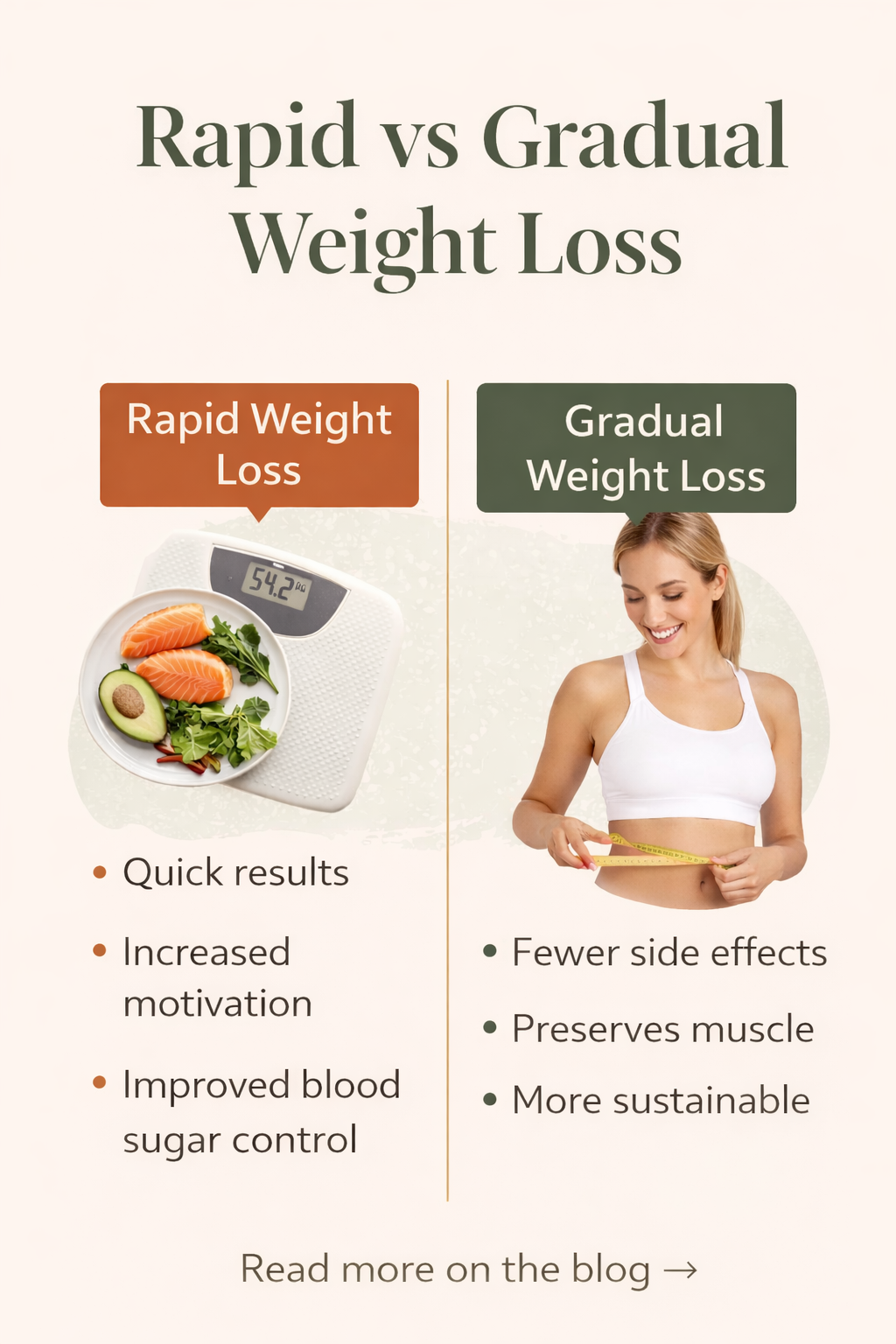

Losing weight is one of the most common health goals—but what’s the best way to do it?
Should you aim for rapid weight loss to see results quickly, or is a slower, gradual approach better for your long-term health?
The answer isn’t as straightforward as many people think. Research shows that both approaches can be effective, but they each come with different benefits, drawbacks, and considerations.
In this article, you’ll discover:
- Which approach leads to greater fat loss
- What happens to muscle mass during weight loss
- Whether rapid weight loss affects your metabolism
- Which strategy is more likely to help you keep the weight off
Let’s look at what the evidence says.
Looking for practical, evidence-based weight loss advice? This article explains what the research says—and if you’d like personalised support, you’ll find information about working with me at the end.
What is Rapid vs Gradual Weight Loss?
- Rapid weight loss (RWL): losing weight quickly, often through very low-calorie diets over a short period (e.g., a few weeks).
- Gradual weight loss (GWL): Losing weight more slowly and steadily over time with moderate calorie restriction.
Does Rapid Weight Loss Lead to Better Results?
Rapid weight loss can produce noticeable changes on the scale in a short time. This can be motivating and may improve short-term health markers such as blood sugar and cholesterol (Ashtary-Larky et al. 2020).
However, faster weight loss does not necessarily mean better overall results.
Research suggests:
- Both rapid and gradual approaches can lead to similar total weight loss over time
- Long-term weight regain appears to be similar regardless of how quickly the weight was lost (Purcell et al. 2014; Ashtary-Larky et al. 2020).
Potential Benefits and Risks of Rapid Weight Loss
Rapid weight loss can have some advantages in the short term:
- Quick results can increase motivation
- Improves metabolic health markers (e.g., blood glucose, LDL cholesterol)
- Can be useful in clinical settings where fast improvements are needed (Ashtary-Larky et al. 2017).
However, these benefits need to be balanced against potential risks.
Risks of Rapid Weight Loss
1. Muscle Loss
Faster weight loss increases the risk of losing skeletal muscle mass, especially without enough protein or exercise (Bagheri et al 2020).
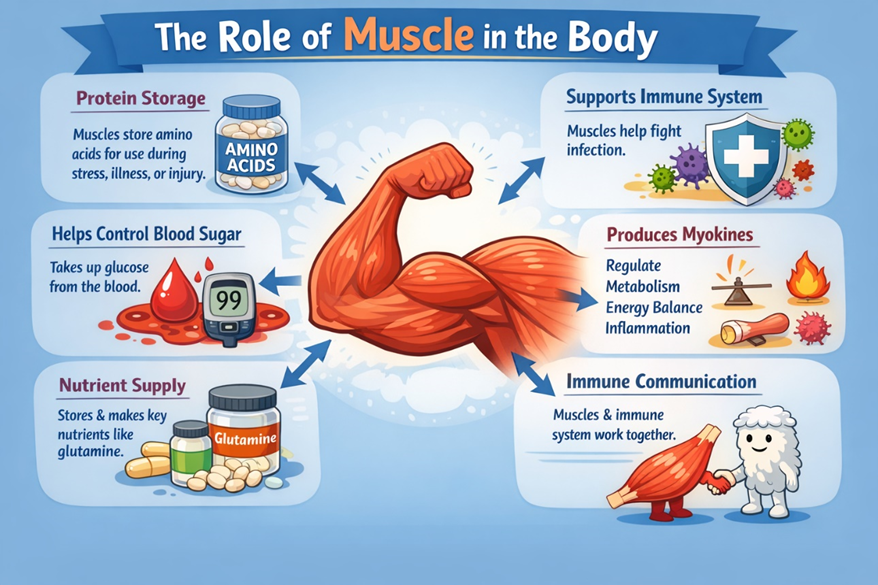
Losing muscle during weight loss is not ideal. Low muscle mass is linked to:
- Higher risk of infections
- Slower wound healing
- Reduced physical function
- Poor immune health (Prado et al. 2024)
This is why preserving muscle should be a priority, regardless of how fast you lose weight.
Hormones and Muscle Growth (Made Simple)
When you lose weight, your body doesn’t just lose fat—it also changes certain hormones that control muscle.
Two important ones are:
- Myostatin → think of this as the brake pedal (it slows down muscle growth)
- Follistatin → this is what lifts your foot off the brake (it helps muscles grow or stay strong)
What happens during weight loss?
Research suggests that gradual weight loss creates a more favourable environment for preserving muscle.
- Gradual weight loss reduces myostatin (the “brake”), making it easier to maintain muscle.
- Both gradual and rapid weight loss reduce follistatin.
- However, during rapid weight loss, the overall hormonal balance may make muscle loss more likely.
In simple terms: losing weight slowly may help your body hold on to more muscle while you’re losing fat (Bagheri et al. 2020).
2. Gallstones
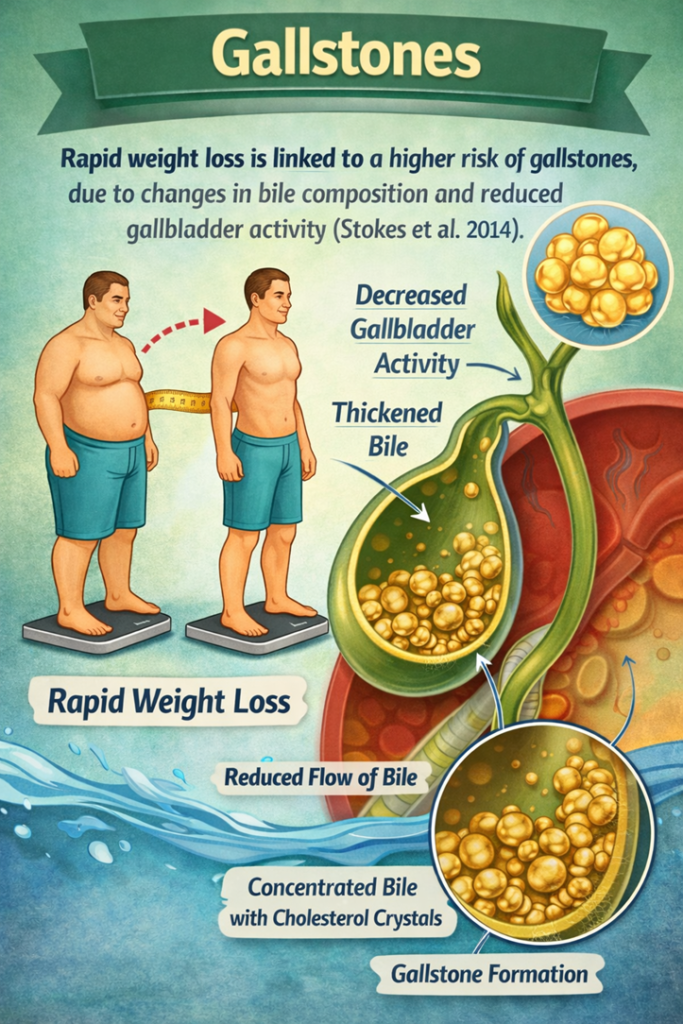
Rapid weight loss is linked to a higher risk of gallstones, due to changes in bile composition and reduced gallbladder activity (Stokes et al. 2014).
A study by Johansson et al. (2014) found that rapid weight loss achieved through a very low-calorie diet resulted in a threefold higher incidence of gallstones compared to slower weight loss achieved through a low-calorie diet.
Gallstones can form when bile contains too much cholesterol and not enough substances (bile salts) to keep it dissolved. If the gallbladder isn’t stimulated—such as during a low-fat diet—the bile stays still and becomes thicker, making stone formation more likely (Johansson et al. 2014).
3. Metabolic Adaptation
A large calorie deficit may lead to a greater reduction in metabolic rate, meaning your body burns fewer calories than before—even at rest—which can make long-term weight maintenance more difficult (Ashtary-Larky et al. 2017).
At the same time, appetite often increases after weight loss. This is a normal biological survival response, not a failure of willpower, and it may contribute to weight regain. More aggressive approaches, such as very low-calorie diets, tend to amplify this effect, making hunger harder to manage. (Nymo et al. 2018).
Is Gradual Weight Loss Better?
Gradual weight loss is often recommended because it:
- Supports better muscle preservation
- Helps maintain metabolic rate
- Encourages sustainable habits
However, it’s important to note:
In itself it does not guarantee better long-term weight maintenance
Fat Loss vs Muscle Loss: What Really Matters?
When losing weight, the goal is usually to reduce body fat while preserving muscle.
Studies suggest that gradual weight loss may be more favourable for body composition, as it is linked to:
- Greater reductions in body fat percentage
- Better preservation of lean mass
However, results are not always consistent, and some studies show minimal differences between approaches (Ashtary-Larky et al. 2017).
Key insight:
Muscle loss is influenced more by diet and exercise than by speed alone.
- Higher protein intake helps preserve muscle mass (1g/kg/day is the minimum recommended to prevent muscle loss and 1.3 is the minimum to increase muscle mass (Kokura et al. 2024)).
- Resistance training plays a major role in maintaining lean tissue
This means you can lose weight quickly or slowly—but without proper nutrition and training, muscle loss can still occur.
Final Thoughts
The most effective weight loss strategy is not just about speed—it’s about consistency, sustainability, and overall health.
Rather than focusing only on how fast you lose weight, it may be more important to consider:
- Can you maintain this approach long term?
- Are you supporting your body with proper nutrition and exercise?
Because in the end, the best diet is the one you can stick to.
Ready to Take a Smarter Approach to Weight Loss?
Sustainable weight loss isn’t about rushing results—it’s about building habits that actually last.
It might be time for a different approach.
I help clients achieve healthy, sustainable weight while also supporting:
- Hormonal balance
- Energy levels
- Pain-free, regular periods
Together, we focus on nutrition, lifestyle, and realistic strategies that fit into your life—so you can feel better long term, not just for a few weeks.
If you’re ready to stop guessing and start feeling in control of your health, get in touch to begin your journey: https://vikihealthyliving.com/
References
Ashtary-Larky, D. et al. (2020). ‘Effects of gradual weight loss v. rapid weight loss on body composition and RMR: a systematic review and meta-analysis’, British Journal of Nutrition, (124), pp. 1121–1132
Ashtary-Larky, D. et al. (2017). ‘Rapid Weight Loss vs. Slow Weight Loss: Which is More Effective on Body Composition and Metabolic Risk Factors?’, International Journal of Endocrinology and Metabolism, 15(3)
Bagheri, R. et al (2020). ‘The effects of gradual vs. rapid weight loss on serum concentrations of myokines and body compositio’, The Journal of Metabolic Diseases,
Johansson, K et al. (2014). ‘Risk of symptomatic gallstones and cholecystectomy after a very-low-calorie diet or low-calorie diet in a commercial weight loss program: 1-year matched cohort study’, (38) pp. 279–284
Kokura, D. (2024). ‘Enhanced protein intake on maintaining muscle mass, strength, and physical function in adults with overweight/obesity: A systematic review and meta-analysis’, Clinical Nutrition ESPEN, (63), pp. 417-426
Nymo, S. (2018). ‘Investigation of the long-term sustainability of changes in appetite after weight loss’, International Journal of Obesity, (42), pp.1489–1499
Prado, C.M. et al. (2024). ‘Muscle Matters: the Impact of Medically Induced Weight Loss on Skeletal Muscle’ Lancet Diabetes Endocrinol 12(11), pp.785-787
Purcell, K. et al. (2014). ‘The effect of rate of weight loss on long-term weight management: a randomised controlled trial’, Diabetes & Endocrinology (2)12, pp. 954-962
Stokes, C.S. et al. (2014). ‘Ursodeoxycholic Acid and Diets Higher in Fat Prevent Gallbladder Stones During Weight Loss: A Meta-analysis of Randomized Controlled Trials’, Clinical Gastroenterology and Hepatology, (12), pp.1090–1100