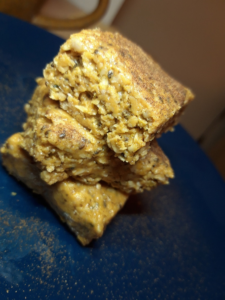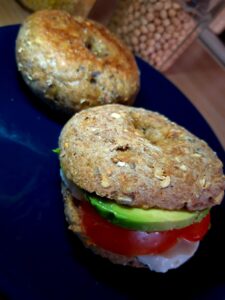
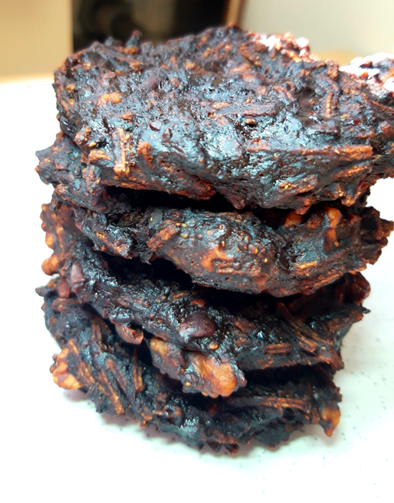
Ingredients:
- 5 bananas
- ¼ cup (25g) cocoa powder
- ¼ cup (30g) cacao nibs
- 1 cup (95g) walnuts
- 75g bran sticks
- 2 tbsp (18g) chia seeds
Instructions
- Preheat the oven to 180°C (350°F) and line a baking tray with baking paper.
- In a large bowl, mash the bananas with a fork until smooth.
- Add the cocoa powder, cacao nibs, walnuts, bran sticks, and chia seeds, and mix well until everything is evenly combined.
- Divide the mixture into 9 portions and shape each one into a cookie on the prepared tray.
- Bake for about 30 minutes, or until the cookies are firm and cooked through.
Good nutrition can support not only digestive health, but also healthy weight management and hormonal balance. If you’d like personalised guidance to support your health goals, you can learn more about my nutritional therapy services on my website: https://vikihealthyliving.com/
| Nutrition Information | Per 1 × 1 cookie — 93g %Reference Intake RI |
| Energy 773.8 kJ / 184.8 kcal | 9 % |
| Fat 10.3g | 15 % |
| Of which Saturates 1.9g | 9 % |
| Of which Mono-unsaturates 1.2g | |
| Of which Poly-unsaturates 5.7g | |
| Carbohydrate 17.4g | |
| Of which Sugars 11.1g | |
| Of which Starches 2.8g | |
| Fibre 7.8g | |
| Protein 4.8g | 10 % |
| Salt 0 g | 0 % |
| Vitamin C 8.2mg | 10 % |
| Vitamin A 0.7µg | 0 % |
| Calcium 29.8mg | 4 % |
| Iron 0.9mg | 6 % |
* Reference Intake Values are based on a 2,000 calorie diet. Your daily values may be higher or lower depending on your calorie needs.
Why Bran Sticks May Be Good for Your Gut
These cereals are rich in wheat bran, which contains special fibres called arabinoxylan oligosaccharides (AXOS). Unlike many nutrients in our diet, these fibres are not digested in the small intestine. Instead, they travel further down the digestive tract to the colon.
And that’s where something interesting happens.
In the colon, these fibres become food for the trillions of bacteria that live in our gut. Scientists are increasingly discovering that feeding the right bacteria can influence digestion, metabolism, and even overall health.
Recent research suggests that the fibres in wheat bran may help support gut bacteria, improve digestion, and influence how the body handles blood sugar.
Here’s what the science shows.
Bran may help beneficial gut bacteria grow
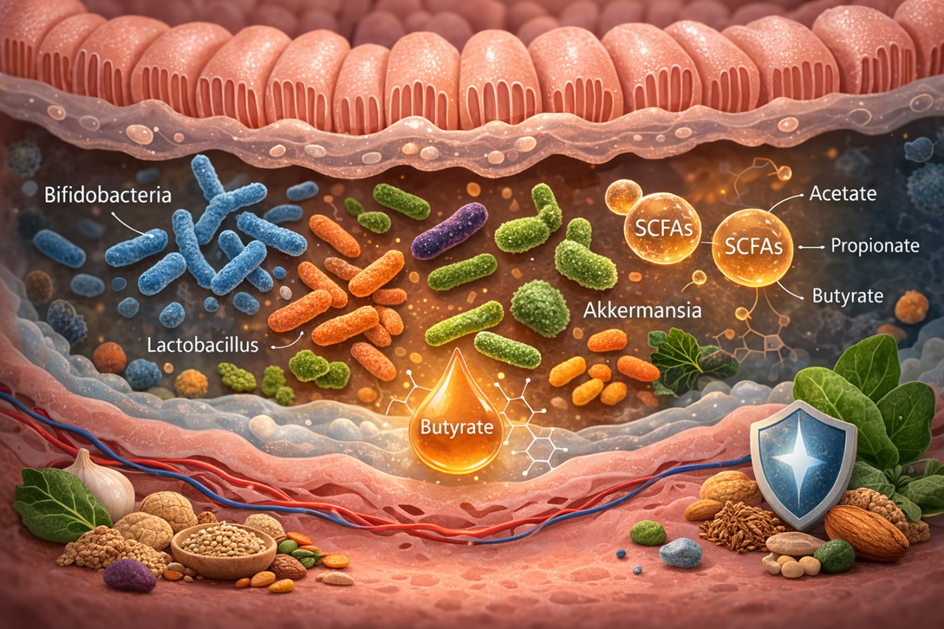
Several studies have found that wheat bran fibres help increase beneficial gut bacteria, especially Bifidobacterium.
These bacteria are often considered “friendly” microbes because they help break down fibre and support a healthy gut environment.
What the studies found
In a study by Muller et al. (2020), people who consumed wheat bran extract rich in AXOS showed an increase in Bifidobacterium in their gut. The researchers also observed smaller increases in other beneficial bacteria such as Akkermansia muciniphila and Lactobacillus.
Another study by Windey et al. (2014) found that wheat bran extract significantly increased a specific species called Bifidobacterium adolescentis, a bacterium known for its role in fermenting fibre in the colon.
In an animal study, Zhang et al. (2025) reported that arabinoxylan supplementation increased bacteria involved in fibre fermentation and improved immune responses.
Why this matters
Bifidobacteria play an important role in maintaining gut health. They help:
- break down dietary fibre
- produce beneficial compounds
- support the gut barrier
- limit the growth of harmful bacteria
Because of these effects, increasing Bifidobacteria is generally considered a positive change for the gut microbiome.
Bran may reduce harmful protein fermentation
Gut bacteria ferment both fibre and protein. But when too much protein reaches the colon, bacteria can produce compounds such as:
- ammonia
- p-cresol
- phenols
In high amounts, these substances may irritate the gut lining.
Research suggests wheat bran may help shift this balance. In the study by Windey et al. (2014), wheat bran extract reduced protein fermentation in the colon. Instead, bacteria appeared to ferment fibre more actively.
In simple terms, fibre from wheat bran may help guide gut bacteria toward a healthier type of fermentation.
Bran supports digestive health
Wheat bran has long been known for its benefits for digestion.
Research shows that AXOS can:
- soften stool consistency
- support regular bowel movements
Interestingly, in the study by Muller et al. (2020), stools became softer even though overall gut transit time did not change significantly. This suggests that wheat bran fibre may improve stool quality without dramatically speeding up digestion.
Bran feeds bacteria that produce beneficial compounds
When gut bacteria ferment wheat bran fibre, they produce substances called short-chain fatty acids (SCFAs), including:
- acetate
- propionate
- butyrate
Experimental research suggests arabinoxylans increase the production of these beneficial compounds and create an environment that favours healthy gut bacteria (Zhang et al., 2025).
What are short-chain fatty acids and why are they important?
Short-chain fatty acids are produced when gut bacteria ferment dietary fibre in the colon.
Butyrate acts as a fuel for the cells lining the gut and helps keep the intestinal barrier strong. Propionate and acetate influence how the body uses energy and processes nutrients.
Together, these molecules help regulate inflammation, blood sugar levels, immune responses, and communication between the gut and other organs such as the brain and liver.
Because of these wide-ranging effects, short-chain fatty acids are now considered an important link between diet, the gut microbiome, and overall health (Ottria et al., 2026).
The bottom line
Bran sticks might seem like a simple high-fibre cereal, but the fibres in wheat bran may do much more than support digestion.
Research suggests they may:
- encourage beneficial gut bacteria
- reduce harmful protein fermentation in the colon
- support regular bowel movements
- help gut bacteria produce beneficial short-chain fatty acids
In other words, by feeding the right microbes in the gut, wheat bran may support a healthier internal environment.
Sometimes, the simplest foods can have surprisingly complex benefits.
References:
Boll, E.V.G. et al. (2015). ‘Effects of wheat bran extract rich in arabinoxylan oligosaccharides and resistant starch on overnight glucose tolerance and markers of gut fermentation in healthy young adults’, Eur J Nutr,
Muller, M. et al. (2020). ‘Effect of wheat bran derived prebiotic supplementation on gastrointestinal transit, gut microbiota, and metabolic health: a randomized controlled trial in healthy adults with a slow gut transit’ Gut Microbes, 12(1)
Ottria, R. et al. (2026). ‘Gut Microbiota-Derived Short-Chain Fatty Acids in Inflammatory Bowel Disease: Mechanistic Insights into Gut Inflammation, Barrier Function, and Therapeutic Potential’ International Journal of Molecular Sciences 27(2)
Windey, K. (2014). ‘Wheat bran extract alters colonic fermentation and microbial composition, but does not affect faecal water toxicity: a randomised controlled trial in healthy subjects’, Cambridge University Press, (113)2
Zhang, G. et al. (2024). ‘Fecal fermentation behavior and immunomodulatory activity of arabinoxylan from wheat bran’, International Journal of Biological Macromolecules, 256